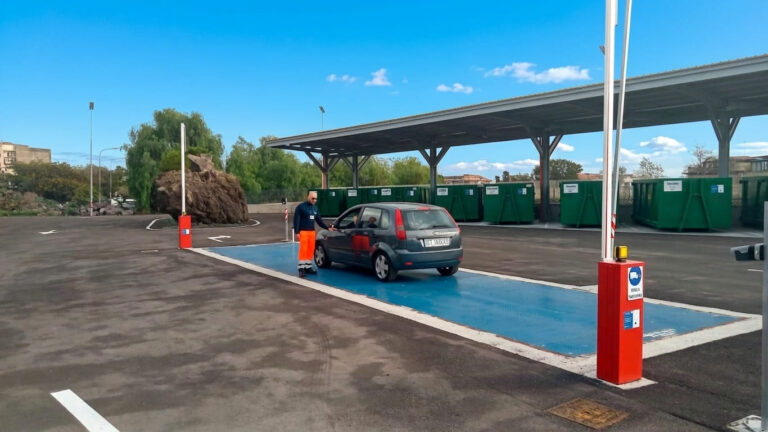


From 14 May 2026 has come into effect Decree of the Ministry of Environment and Energy Security of 26 March 2026 – published in Official Gazette no. 98 of 29 April 2026 – which introduces completely new regulations for the collection centres for urban waste collected separately. The measure definitively replaces the legislation in force since 2008 and represents an important step towards a more modern, efficient, and digital management of the service.
The decree is aimed at Municipalities, Area Governing Bodies, and waste management operators, who are called upon to adapt Collection Centres according to new organisational, management, and technological criteria, with the aim of improving the quality of separate waste collection, increasing material recovery, and promoting the development of the circular economy.
Let's discover together the new features introduced and how Sikuel – Maggioli Group can support those involved in implementing the new provisions.
The main innovations introduced by the decree
The new regulatory framework organically governs the technical-structural characteristics of Collection Centres, the requirements for their management, the types of waste that can be deposited, and the operational methods.
Among the most relevant aspects are:
- new regulations for the design and adaptation of Collection Centres, with particular attention to safety, environmental protection and the functionality of the disposal areas;
- a more precise definition of the management methods for different types of waste, including fractions requiring special conservation and handling measures, such as WEEE, batteries, liquid waste, biodegradable waste, and hazardous waste;
- obligation for qualified and adequately trained personnel for the management of the Collection Centre;
- the possibility of allocating specific areas for the reuse and preparation for reuse of still-functional goods, concretely promoting the principles of the circular economy.
The decree also confirms the strategic role of Municipalities and Area Authorities, which are responsible for regulating, through specific regulations, the organisation of the Collection Centre, the types of waste that can be deposited, and user access procedures.
Traceability and digitisation: the real leap forward
However, the most innovative element of the provision concerns information management.
The decree introduces a strongly oriented approach to traceability of contributions and digitisation of processes, anticipating intake and output waste accounting procedures aimed at the preparation of Mass Balances or Volumetric Balances. These procedures can be managed through IT tools and include specific operating sheets attached to the decree.
Another important development concerns the possibility of adopting systems for recording user details, the number of waste disposal events, and the different waste streams disposed of within the framework of pay-as-you-throw waste measurement systems. This is a fundamental step for all Authorities that are developing or intend to develop pay-as-you-throw tariff models.
The Collection Centre therefore takes on a new role: not only a place for waste disposal, but a strategic hub for collecting reliable, certified and interoperable data, essential for improving service management.
The expected timescales
The existing Collection Centres can continue to operate, but they will have to comply with the new regulations by twelve months from the entry into force of the decree, so by 14 May 2027. The Ministerial Decree of 8 April 2008 and the Ministerial Decree of 13 May 2009 are repealed at the same time, being entirely replaced by the new discipline.
The planning phase for the necessary interventions has therefore already begun for Municipalities and managers, both from an infrastructural perspective and, above all, from an organisational and digital point of view.
The Waste collection centre management software According to the new decree: K-Tarip
The MASE's new provisions confirm a clear direction: the management of Collection Centres requires tools capable of ensuring traceability, control over deliveries, and immediate data availability.
In this context, K-Tarip suite represents a complete solution for the computerised management of Collection Centres, already adopted in over 250 installations.
The platform integrates dedicated software and hardware devices, allowing for the management of all operational stages of the Collection Centre:
- utility identification;
- access control;
- recording and certification of contributions;
- waste flow accounting;
- collection of data necessary for the preparation of Mass Balances;
- interoperability with the management systems already used by the operator and the Authority.
K-Tarip also supports the implementation of pay-per-use charging., providing reliable, up-to-date, and easily accessible data.
The solution is ACN certified and Fully compliant with ARERA, features that guarantee high standards of safety, reliability, and regulatory compliance.
An opportunity to innovate the service
The Decree of 26 March 2026 is not merely a regulatory update. It introduces a new management model for Collection Centres, in which organisation, data quality, and digitalisation become fundamental elements for improving service efficiency and increasing the quality of separate waste collection.
For municipalities and managers, adapting means not only complying with regulations but also seizing the opportunity to make the service more efficient, transparent, and ready to face the future challenges of waste management and pay-as-you-throw tariffs.
For more information, contact us on 0932 667555 / 348 6185167, or write to us at commerciale@sikuel.it or fill in the form and we'll get back to you.