

Resolution 387 of 3 August 2023 from ARERA introduces an intangible data infrastructure to monitor the actual performance of waste collection/transport operators and plant operators, extending to the entire supply chain what was already done by previous resolutions. 15/2022 TQRIF and 444/2019 in terms of quality and transparency.
The Authority places greater responsibility on the Territorial Competent Bodies, as, specified in Title VII, they will have to collect and communicate the data concerning the indicators identified by the collection and transport manager.
The application of the obligations contained in Resolution 387 is scheduled for 1st January 2024 and is divided into titles as follows:
SCOPE OF APPLICATION – TITLE I
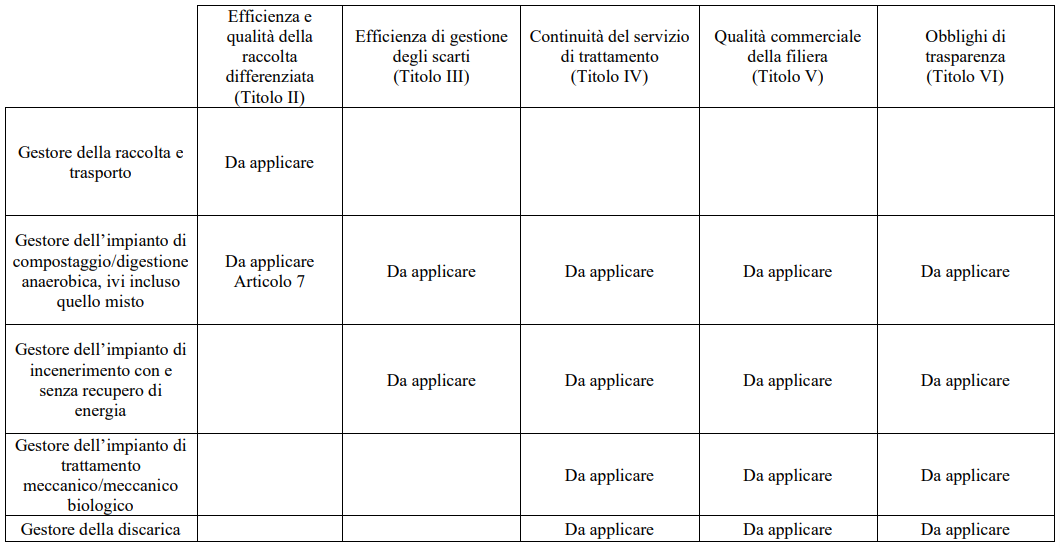
EFFICIENCY AND QUALITY OF SEPARATE COLLECTION – TITLE II
- Efficiency of separate collection of waste streams subject to extended producer responsibility obligations
- It is determined by the ratio between the quantity supplied and withdrawn from the platforms or plants and the quantity collected
- Start of organic waste recycling
- It is determined by the ratio between the quantity sent to composting/anaerobic digestion plants and the quantity collected.
- Quality of separate collection of waste streams subject to extended producer responsibility obligations
- It is defined by the ratio between the revenues recognised by the Supply Chain Consortia and those that would be realised by applying the maximum fees.
- Effectiveness of the recycling start for fractions subject to extended producer responsibility obligations
- It is expressed by the product of the separate collection efficiency and its relative quality
- Quality of separate collection of organic waste
- It is determined based on the fractions not admitted for recycling, as identified by the commodity analyses carried out on the materials submitted.
WASTE MANAGEMENT EFFICIENCY – TITLE III
- Incidence of waste
- It is defined by the ratio between the amount of waste generated by the treatment of urban waste and the total amount of urban waste treated at the plant.
- Waste management efficiency
- It is defined as the ratio between the amount of waste sent for material and energy recovery and the total amount of waste generated by the treatment plant.
CONTINUITY OF TREATMENT SERVICE – TITLE IV
- Notice period
- The time in hours between user notification and the start of the interruption
- Number of interruptions
- Sums of breaks with and without notice
- Duration of interruptions
- Time spent on individual breaks, with and without notice
Commercial quality of the supply chain – Title V
- Average response time for reasoned written complaints
- Average response time for reasoned written information requests
- Average response time for reasoned replies to written requests for billing corrections
TRANSPARENCY OBLIGATIONS – TITLE VI
The operators of treatment plants are required to prepare and keep up-to-date a dedicated section of their website, easily accessible from the homepage, which presents at least the following minimum information, organised in a way that promotes understanding of the information:
- Telephone and email contacts
- Opening hours of the facility
- Notifications to contributing users
- any communications to the contributing users by the Authority
- actual performance achieved by the plant with reference to the indicators that are the subject of this provision (Resolution 387 ARERA)
- Economic conditions for accessing the facility
MONITORING, RECORD-KEEPING AND COMMUNICATION OBLIGATIONS – TITLE VII
- Monitoring and Communication Obligations to the Authority and the Competent Territorial Body
In each year, and with reference to the previous year's figures, they are required to transmit to the Authority, according to the timings and procedures established by the latter:
- The territorially competent body, the data relating to the indicators identified by the collection and transport operator
- Facility managers for their respective areas
- Registration obligations
The waste collection and transport manager and the treatment plant manager must prepare a register, available on a dedicated IT platform, in order to record the information and data relating to the indicators within its remit
- The waste collection and transport manager must record:
- the quantity corresponding to the fractions subject to extended producer responsibility obligations assigned and collected by platforms and the related quantity collected
- the quantity of organic fraction sent for composting/anaerobic digestion and the related quantity collected
- The percentage of fractions not admitted for recycling
- The treatment plant manager must record on an annual basis:
- the amount of waste generated by the treatment plant, expressed in tonnes
- the amount of municipal waste as a whole treated by the plant, expressed in tonnes
- the quantity of waste sent for energy recovery
- The amount of waste generated by the plant
- The start date and time of the interruption
- the cause of the interruption
- the classification of interruption
- The start date and time of the interruption
- the cause of the interruption
- the classification of the interruption (with or without notice)
- the notice period, specifying the event that caused the notice
- The date and time of the end of the interruption
- For each complaint, written request for information, written request for invoicing relating to the treatment service
-
- the traceability code with which it identifies the individual service request
- the code with which it identifies the service
- the identifying data of the donating user, such as: company name and tax code/VAT number
- the date of receipt of the service request
- The date of the dispatch of the reasoned written response
- the reason for and date of the potential termination of the obligation to proceed with the request or complaint
Photos of Sigmund on Unsplash
Contact us for more information on 0932 667555 or 3486185167